Net Quantity Declarations on Food Labels: What 21 CFR 101.7 Actually Requires
By Eiman Raouf, July 23, 2026
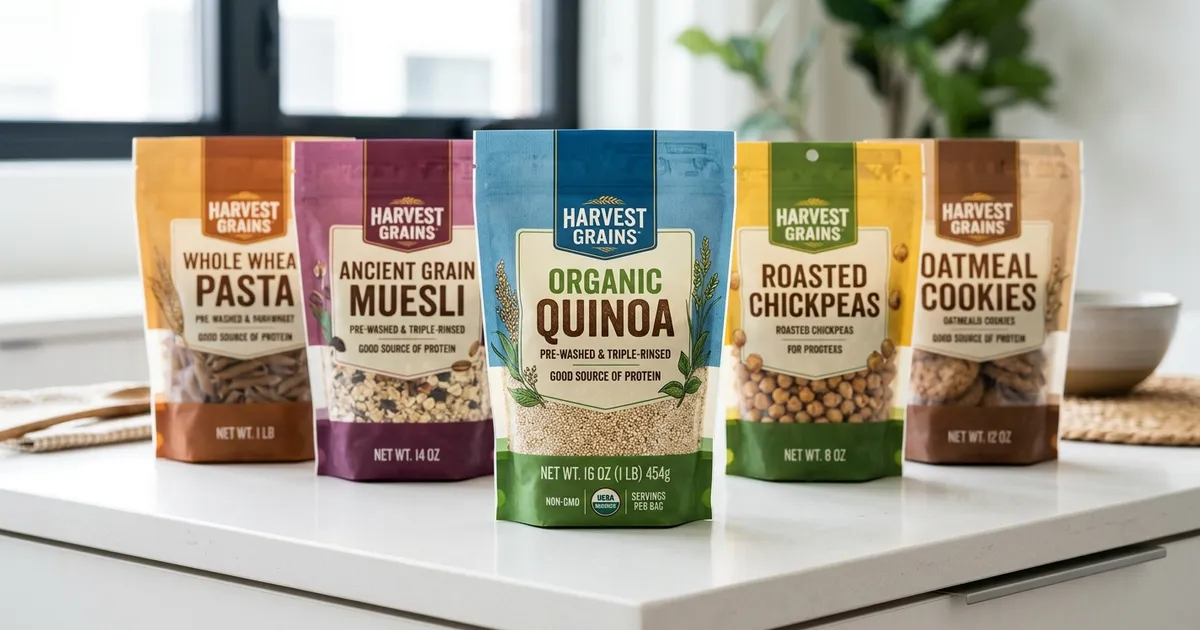
Some failure modes do not announce themselves. The Nutrition Facts panel looks correct. The ingredient statement is in order. The allergen declaration is complete. And then the label comes back from compliance review flagged for the weight statement, the “NET WT 8 oz (227 g)” in the lower corner that no one thought twice about.
Net quantity declarations are one of the quieter requirements in food labeling. They are not complicated in concept, but they carry specific rules about where the statement must appear, how large the type must be, which units are required, and what format the numbers must take. A statement that has the right number in the wrong place, or the right place in the wrong type size, or the right type size but missing the metric equivalent, is still a non-compliant label.
What the requirement is and where it comes from
The net quantity declaration is required on every packaged food sold at retail in the United States. Two pieces of law work together here. The Fair Packaging and Labeling Act (FPLA), the federal statute, requires a net quantity statement on consumer packaged goods and, since its 1992 amendment, requires that statement to include both US customary and metric units. 21 CFR 101.7 is FDA’s implementing regulation, which translates the FPLA into the specific format, placement, and type size rules that appear on your label.
The declaration must accurately reflect the amount of food in the package, exclusive of wrappers and any other packing material. For liquid foods, that means fluid measure. For solid and semisolid foods, that means weight. For some products, a count is appropriate, either alone or combined with a weight or measure declaration.
One rule that sounds obvious but gets tested during label review: no qualifying language. The declaration cannot include terms like “jumbo quart,” “full gallon,” or “generous ounce.” The number and the unit stand alone.
Where the statement must go
The net quantity declaration must appear on the principal display panel, the part of the label most likely to be seen by the consumer at the point of purchase. It cannot be placed on a side panel, a back panel, or a flap.
Within the principal display panel, the declaration must appear in the bottom 30 percent of the panel area, in lines generally parallel to the base of the package as it is designed to be displayed. A 12-ounce jar of salsa, displayed upright on a shelf, has its net quantity statement in the bottom 30 percent of the front label. If the front panel is 4 inches tall, the statement needs to be within the bottom 1.2 inches.
There is one exception to the bottom-30-percent placement rule: packages with a principal display panel of 5 square inches or less are exempt from the bottom-30-percent requirement. The statement still has to be on the principal display panel; it just is not required to be at the bottom.
The declaration also needs breathing room. It must be separated from other label text above or below it by at least a space equal to the height of the lettering used in the declaration. On the sides, it must be separated from adjacent text by at least a space equal to twice the width of the letter “N” in the typeface used for the declaration. This is not a design preference. It is part of the regulation.
How large the type must be
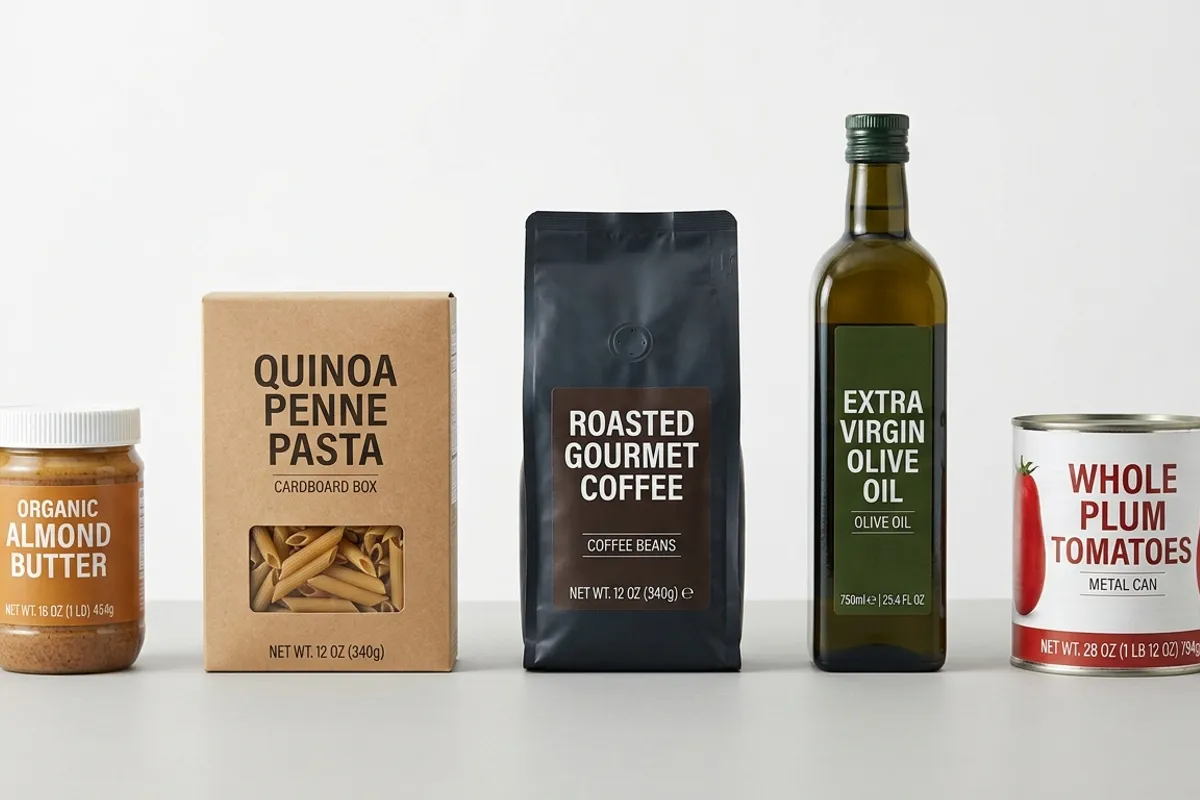
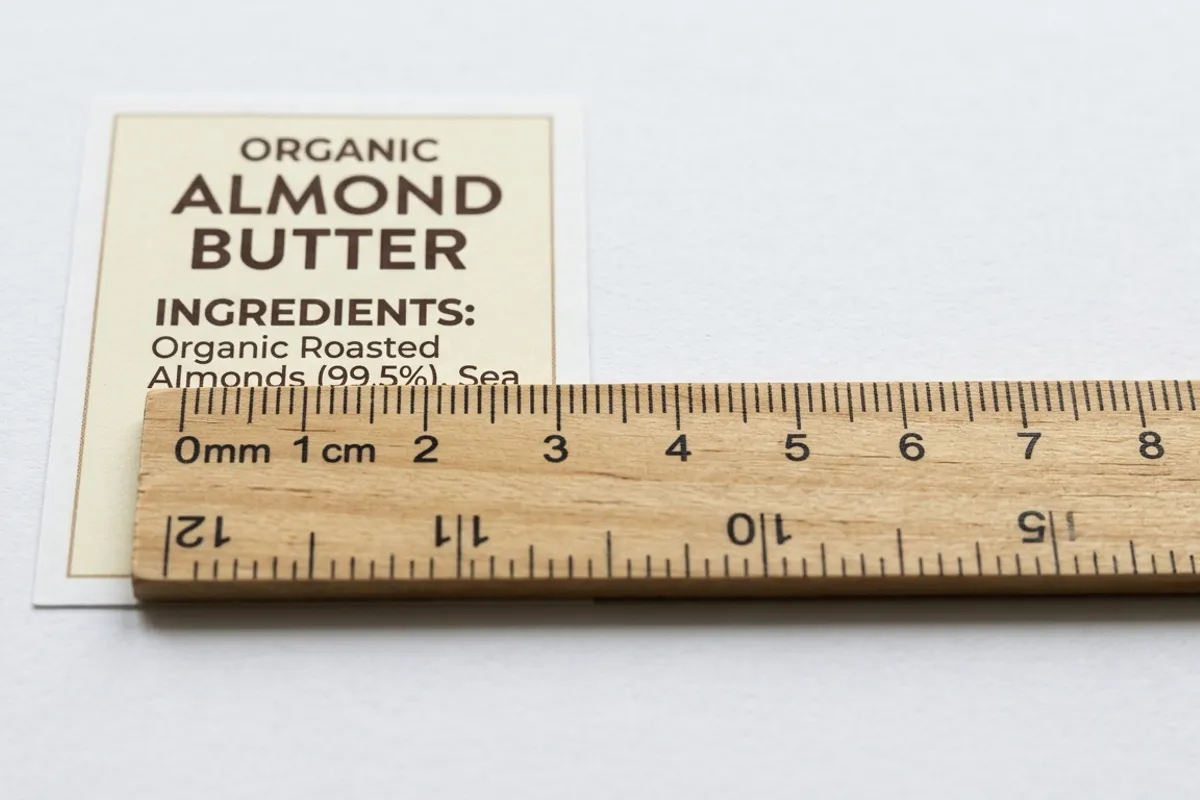
The minimum type height is set by the size of the principal display panel, measured by the lowercase letter “o” in the typeface used for the declaration. The regulation at 21 CFR 101.7(i) specifies four tiers:
| Principal Display Panel Area | Minimum Type Height |
|---|---|
| 5 square inches or less | 1/16 inch (1.6 mm) |
| More than 5 to 25 square inches | 1/8 inch (3.2 mm) |
| More than 25 to 100 square inches | 3/16 inch (4.8 mm) |
| More than 100 square inches | 1/4 inch (6.4 mm) |
There is a condensed-font rule as well: the height-to-width ratio of the letters used must not exceed 3 to 1. A typeface three times taller than it is wide sits at the limit. More compressed than that, and the declaration does not comply regardless of the nominal point size.
The type must be in boldface and must contrast clearly with the background, whether by color, embossing, or layout. A weight statement that blends into the background of a busy label design is not compliant even if it technically appears in the right location at the right size.
One practical consequence: designers who size the label at a standard 12-point type for everything on the back panel and then shrink the net quantity statement to fit a tight layout will often produce a statement that falls short of the minimum. Calculating the principal display panel area and applying the correct minimum before the layout is finalized is the cleaner approach.
Which units you must use
For FDA-regulated packaged foods, both US customary units and metric units are required. The FPLA’s 1992 amendment made dual declaration mandatory. FDA never fully amended 21 CFR 101.7 to reflect this, but the statute governs, and compliance review will flag a label that carries only ounces.
The standard format is: US customary unit first, followed by the metric equivalent in parentheses, or both grouped together. For example: NET WT 12 oz (340 g) or NET 16 fl oz (473 mL).
For weight declarations:
- Under 1 pound, use ounces and grams: NET WT 6 oz (170 g)
- At 1 pound or more, express in pounds and ounces: NET WT 1 lb 4 oz (567 g), or in decimal form: NET WT 1.25 lb (567 g)
- Metric equivalent in grams or kilograms as appropriate
For liquid content declarations:
- Use fluid ounces and milliliters or liters: NET 8 fl oz (237 mL)
Common fractions in the US customary portion must be reduced to lowest terms. “6/8 oz” is not acceptable; it should be “3/4 oz.” If using a decimal fraction, carry it no further than two decimal places.
The labels produced for USDA-regulated products (most meat and poultry) have historically followed similar requirements under 9 CFR 317.2 and 381.121, though USDA FSIS rescinded its own dual declaration requirement for meat and poultry products in 2022 (FSIS Notice 61-22). Single-unit declarations are now permissible for those products, meaning a pork loin package may state just “NET WT 2.5 LB” without the metric equivalent. That exemption applies only to USDA-regulated products. It does not extend to FDA-regulated foods.
Exemptions worth knowing
Two categories of products have narrower obligations.
Retail-weight packages (often called random-weight packages in the regulation) are packages labeled at a retail establishment with the actual weight determined at point of sale, like a deli counter package of sliced cheese or a butcher’s custom-cut steak. These packages, bearing labels with net weight, price per pound, and total price, are exempt from some of the type size, placement, and dual declaration requirements of 21 CFR 101.7, as long as the net weight is accurately stated in a conspicuous location.
Bulk containers received at retail establishments and measured out in the customer’s view, or measured per the customer’s order, are exempt from the net quantity declaration requirement entirely for the retail package.
Neither of these applies to pre-packaged products shipped to retail and placed on the shelf as-is. For those, 21 CFR 101.7 applies in full.
How Canada handles it differently
For founders selling in both the US and Canada, the difference in unit requirements matters. Under the Consumer Packaging and Labelling Act (CPLA) and its regulations, Canadian labels must declare net quantity in metric units (grams or kilograms for solids, millilitres or litres for liquids), with the metric declaration appearing first on the principal display surface. Canadian units such as ounces and pounds may follow, but metric leads and is mandatory.
A US label reading “NET WT 8 oz (227 g)” does not satisfy Canadian requirements. The Canadian label needs “227 g / 8 oz,” metric first, with both languages if the declaration appears in text form on a bilingual label.
Minimum type size in Canada is governed by Schedule 6 of the Safe Food for Canadians Regulations (SFCR), which scales minimum character heights based on the area of the principal display surface. The numeric portion of the declaration must appear in boldface type. The units must appear in characters of at least 1.6 mm height (measured by the lowercase “o”), consistent with Canada’s general legibility requirements for food labels.
These are not the same requirements. A single label design cannot satisfy both 21 CFR 101.7 and the CPLA without careful attention to which requirement is more stringent for each element, and both sets of requirements still need to be checked against the final artwork before print.
Where the errors show up in practice
In label review, net quantity problems tend to fall into a handful of categories. The statement is on the back panel instead of the principal display panel. The statement is at the top of the front label rather than the bottom 30 percent. The type is within the minimum height range for the panel area but uses a highly condensed font that exceeds the 3:1 ratio. The metric equivalent is missing entirely, or it is present but incorrectly converted. The fraction in the US customary portion is not reduced to its lowest terms.
Each of these is fixable. The problem is that they are typically discovered when an artwork file is already complete, which means a revision, another round of design, and additional review time before anything can go to print.
Catching these requirements before the artwork is built costs nothing. Catching them after the plates are made means paying for the print run twice.
At Complion, every label we build includes the net quantity declaration formatted to the applicable regulatory requirements (FDA 21 CFR 101.7 for US products, CPLA and SFCR for Canadian products), and our compliance team verifies the placement, type size, and unit declarations against the final artwork before anything leaves for print. If you are building a first label or want to make sure an existing one holds up, book a free call to start.
Rather not learn all this yourself?
Send us your recipe or idea on a free call. We build the full compliant label, the Nutrition Facts panel, the ingredient statement, the allergen declarations, and the print-ready artwork, then our experts verify it against FDA, USDA, Health Canada, and CFIA before it reaches you.
Book a free call to start