"Calcium Builds Strong Bones" Is Fine. "Reduces Risk of Osteoporosis" Requires FDA Permission.
By Eiman Raouf, August 24, 2026
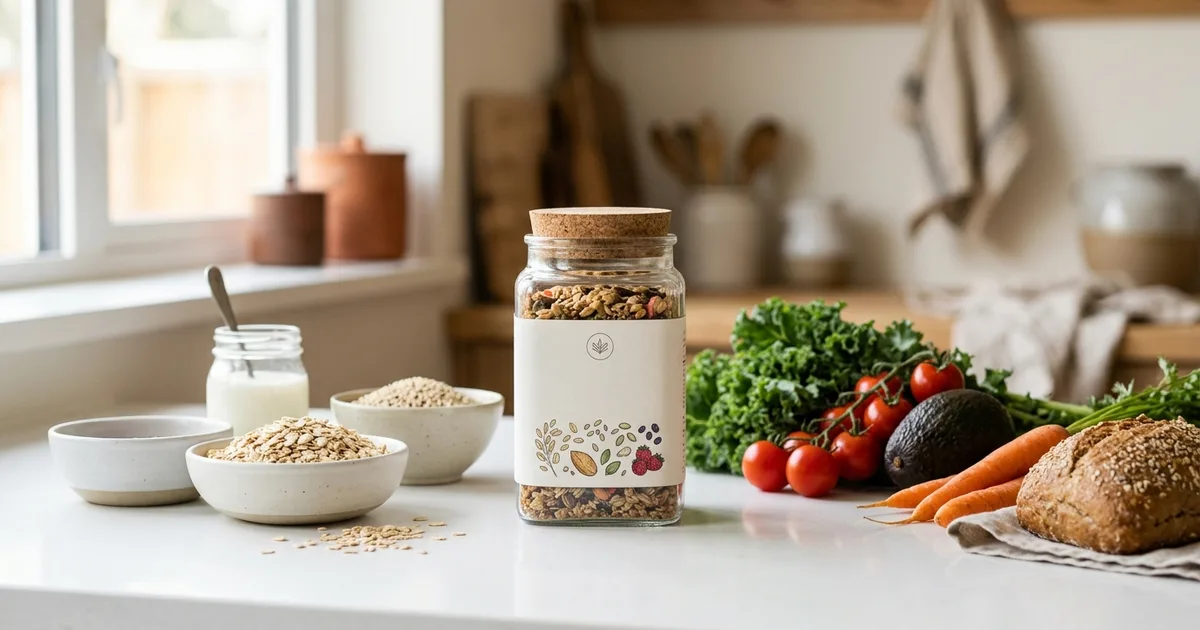
There is a sentence that shows up on a lot of packaged food labels: “Calcium builds strong bones.” Most founders who put it there assume it is a health claim. It is not. Under FDA’s framework, that is a structure/function claim, and it operates under a completely different set of rules than a health claim does.
The sentence that is a health claim: “Adequate calcium throughout life, as part of a well-balanced diet, may reduce the risk of osteoporosis.” That version requires FDA pre-authorization. Using it on a label means your product must comply with the specific requirements in 21 CFR 101.72. Using it on a product that does not qualify, or getting the wording wrong, makes the label misbranded under 21 U.S.C. 343.
Founders who write label copy without knowing this distinction end up in one of two places: they water down strong claims out of excessive caution, or they put disease-reduction language on a label that was never authorized to carry it. Both are problems, and both are avoidable.
Three categories, three sets of rules
FDA recognizes three types of claims relating to nutrients and health on food labels. They are not interchangeable.
Structure/function claims describe what a nutrient or ingredient does in the body. “Calcium builds strong bones.” “Fiber maintains digestive health.” “Iron supports red blood cell production.” These describe biological structure or function. They do not reference a disease and do not imply that eating this product prevents or reduces the risk of any medical condition.
For conventional foods (not dietary supplements), structure/function claims do not require FDA pre-approval and do not require a disclaimer. They must be truthful, not misleading, and derived from nutritive value. That is the bar.
Authorized health claims describe a relationship between a substance and a disease or health-related condition. “Diets low in saturated fat and cholesterol may reduce the risk of heart disease.” “Adequate calcium as part of a healthful diet, along with physical activity, may reduce the risk of osteoporosis in later life.” These are not copywriting choices a founder makes freely. Each one is codified in regulation under 21 CFR Part 101, Subpart E. FDA authorized each claim after finding that the scientific evidence met the significant scientific agreement (SSA) standard, the highest evidentiary threshold in FDA’s labeling framework.
Qualified health claims sit between the two. The science is credible but has not reached SSA. FDA has not codified the claim in regulation, but it has issued an enforcement discretion letter permitting the claim as long as qualifying language accompanies it. An example from nuts and heart disease: “Supportive but not conclusive research shows that eating 1.5 ounces per day of most nuts, as part of a diet low in saturated fat and cholesterol, may reduce the risk of heart disease.” The disclaimer is not optional.
What it takes to use an authorized health claim
Using one of the authorized health claims in 21 CFR Part 101, Subpart E is not simply a matter of picking the right language. Your product has to qualify.
The first test is the disqualifying nutrient check. Under 21 CFR 101.14(a)(4), a food cannot carry a health claim if it exceeds any of these levels per reference amount customarily consumed and per label serving size:
- 13.0 grams of total fat
- 4.0 grams of saturated fat
- 60 milligrams of cholesterol
- 480 milligrams of sodium
For small reference amounts (30 grams or less, or 2 tablespoons or less), the test also applies per 50 grams. For meal products, the thresholds scale up to 26.0 g fat, 8.0 g saturated fat, 120 mg cholesterol, and 960 mg sodium per serving. For main dish products, they are 19.5 g fat, 6.0 g saturated fat, 90 mg cholesterol, and 720 mg sodium per serving.
A product that exceeds any one of these levels in any applicable category is disqualified from bearing a health claim, regardless of whether the claim language is correct and regardless of the underlying ingredient relationship.
The second test is the 10% rule. Under 21 CFR 101.14, a conventional food may not bear a health claim unless it contains, prior to any nutrient addition, at least 10 percent of the Daily Value for at least one of the following: vitamin A, vitamin C, iron, calcium, protein, or dietary fiber per reference amount customarily consumed.
This is sometimes called the jelly bean rule because it was designed to prevent high-sugar confections with no nutritional merit from carrying health claims by adding a single authorized substance.
The third test is the claim-specific requirement. Each authorized health claim has its own regulation with its own substance thresholds and wording requirements. The calcium, vitamin D, and osteoporosis claim under 21 CFR 101.72 requires that the food contain at least 20 percent of the Daily Value for calcium per reference amount customarily consumed, and if the product contains phosphorus, it must also meet a specified calcium-to-phosphorus ratio under that regulation. If your product contains calcium but does not meet that threshold, you cannot use the osteoporosis claim even if the product passes the disqualifying nutrient levels and the 10% rule.
The current list of authorized health claims under 21 CFR Part 101, Subpart E covers substances including: calcium and vitamin D and osteoporosis (101.72), dietary fat and cancer (101.73), dietary saturated fat and cholesterol and risk of coronary heart disease (101.75), fiber-containing grain products, fruits, and vegetables and cancer (101.76), fruits, vegetables, and grain products containing fiber and risk of coronary heart disease (101.77), folate and neural tube defects (101.79), dietary noncariogenic carbohydrate sweeteners and dental caries (101.80), soluble fiber from certain foods and risk of coronary heart disease (101.81), soy protein and risk of coronary heart disease (101.82), and plant sterol and plant stanol esters and risk of coronary heart disease (101.83).
If your intended claim is not in that list, it is not an authorized health claim. Using that language on a label without authorization, regardless of how accurate the science behind it is, makes the label misbranded.
How qualified health claims actually work
Qualified health claims emerged from the FDA’s Consumer Health Information for Better Nutrition Initiative, which began in 2003. The goal was to allow claims supported by credible science that had not yet reached SSA, provided that the claim was phrased in a way that accurately communicated the level of certainty.
The mechanism is an enforcement discretion letter. A petition is submitted to FDA under 21 CFR 101.70. If FDA concludes that the evidence is credible and that a properly qualified claim would not mislead consumers, it issues a letter specifying the exact language that should accompany the claim. That language is not a summary of the letter. It is the required disclaimer, and it must appear prominently and conspicuously.
The practical consequence is that qualified health claims tend to look awkward on a label. “Very limited and preliminary scientific research suggests…” is not the kind of language that fits cleanly on a package front. Founders who want to make claims about emerging science often find that the qualified health claim route requires more careful label design than they anticipated.

Where the confusion creates real problems
The most common mistake is using disease-reduction language when structure/function language would have been both accurate and sufficient. “Supports heart health” is a structure/function claim for a conventional food. “May reduce the risk of heart disease” is not. Founders sometimes write the second version because it sounds stronger, without knowing that the first version is permissible and the second version requires either an authorized health claim qualification (with all of the product requirements that follow) or a qualified health claim disclaimer.
The second common mistake is using an authorized health claim on a product that does not qualify. A high-sodium product with an otherwise accurate calcium-osteoporosis claim is still misbranded. The claim language is correct; the product is not eligible.
The third mistake is assuming that because a claim appeared on a competitor’s product, it is acceptable. Health claims in the market are sometimes wrong. A compliance review is not a sweep of what your competitors have printed.
If you are building a first label or writing copy for a product that makes any reference to health, disease risk, or body function, the claim category matters before anything else. At Complion, our food compliance experts review claim language against FDA’s current framework as part of the label build. If you are not sure which category applies to what you want to say, book a free call to start.
Rather not learn all this yourself?
Send us your recipe or idea on a free call. We build the full compliant label, the Nutrition Facts panel, the ingredient statement, the allergen declarations, and the print-ready artwork, then our experts verify it against FDA, USDA, Health Canada, and CFIA before it reaches you.
Book a free call to start