Gluten-Free Claims on Food Labels: FDA and Health Canada
By Eiman Raouf, July 6, 2026
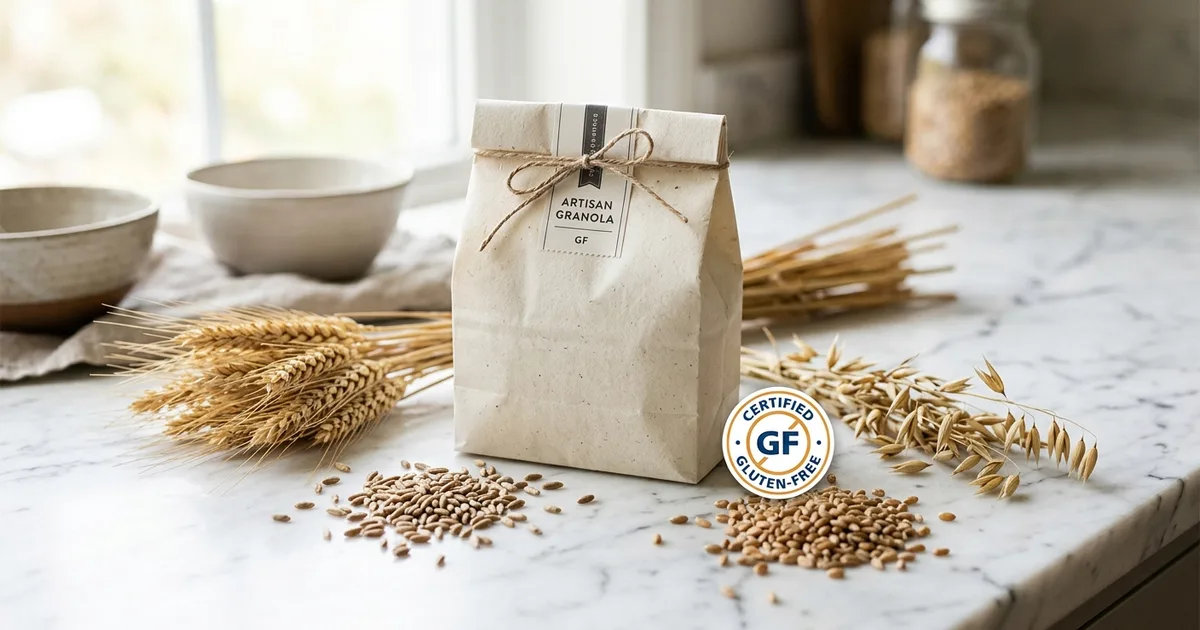
There is a common misread of the gluten-free claim: that it is something you put on a label when you want to signal to health-conscious shoppers. That reading gets it exactly backwards.
Under US and Canadian law, “gluten-free” is a regulated claim with specific conditions. Using it means your product and your production process have to meet those conditions. Putting it on a product that contains gluten is not an option, and neither is putting it on a product whose supply chain cannot demonstrate the standard was met.
For founders building a first label, this matters in two directions. If your product genuinely contains no gluten, you need to understand what the regulations actually require before you print the claim. And if your product does contain gluten-containing grains, you need to understand why that affects more than just the front-of-pack text.
What FDA requires
The governing regulation is 21 CFR 101.91, which FDA finalized in 2013 with full compliance required from that year forward. The rule defines “gluten-free” and establishes the conditions a food must meet to use the claim or any equivalent statement.
The gluten-containing grains covered by the regulation are wheat (any species in the genus Triticum), rye (Secale), barley (Hordeum), and their crossbred hybrids. The most common crossbred hybrid is triticale, a cross between wheat and rye. If an ingredient comes from any of these grains, it is a gluten-containing grain under the regulation.
A food may bear the “gluten-free” claim only if it meets all of the following:
First, it contains no ingredient that is itself a gluten-containing grain. Second, it contains no ingredient derived from a gluten-containing grain that has not been processed to remove gluten. Third, if it contains an ingredient derived from a gluten-containing grain that was processed to remove gluten, the use of that ingredient does not result in 20 parts per million or more of gluten in the finished product. And fourth, any unavoidable gluten present in the food from cross-contamination must be below 20 ppm.
That 20 ppm threshold reflects scientific consensus on the level considered safe for the majority of people with celiac disease. It is not a tolerance band. The intent is that foods bearing the claim approach as close to zero as good manufacturing practice allows, with 20 ppm as the enforcement limit.
The regulation also covers equivalent claims. A label bearing “free of gluten,” “without gluten,” or “no gluten” is subject to the same standard as “gluten-free.” The wording is interchangeable for regulatory purposes; the conditions are not.

Fermented and hydrolyzed foods
Fermented and hydrolyzed products create a specific complication: no scientifically validated analytical method exists that can reliably detect and quantify gluten in fermented foods in terms of equivalent intact gluten protein. Soy sauce fermented from wheat, malt vinegar derived from barley, and beer all fall into this category.
In August 2020, FDA issued a final rule addressing this gap, with a compliance date of August 13, 2021. For fermented or hydrolyzed foods bearing a gluten-free claim, FDA evaluates compliance based on records kept by the manufacturer, rather than by testing the finished product. A manufacturer needs to demonstrate, through documentation, that the product was made from gluten-free ingredients before fermentation or hydrolysis, and that production controls were in place to prevent cross-contact.
This has real implications for anyone making kombucha, certain hot sauces, fermented grain-based products, or anything where a gluten-containing ingredient might have been used in the process. The claim requires a paper trail, not just a finished-product test.
The oat question
Oats occupy unusual ground under 21 CFR 101.91. The regulation does not classify oats as a gluten-containing grain. Wheat, rye, barley, and their hybrids are listed; oats are not. Under FDA rules, a product containing oats can be labeled gluten-free, provided the finished product contains less than 20 ppm of gluten and meets all other conditions.
The practical problem is that commercially grown oats are frequently cross-contaminated with wheat during farming, transportation, and processing. A label carrying “gluten-free” on an oat-containing product is a commitment that the oats used and the finished product both fall below 20 ppm. That requires testing, supplier documentation, or both. The claim on the front panel creates that obligation; the oat ingredient does not eliminate it.
FDA acknowledged this issue explicitly in its January 2026 Request for Information on gluten labeling and cross-contact, issued in response to a citizen petition. The RFI signals that FDA may require future changes to how rye, barley, and oats are disclosed in ingredient lists, particularly in cases where they appear under non-transparent names like “malt extract” (derived from barley) or where they appear as processing aids without full source disclosure. The comment period closed in April 2026. Any resulting rule would go through a formal rulemaking process, but the direction of FDA’s attention is clear.
How Canada’s rules differ
Canada’s gluten-free claim framework sits in Section B.24.018 of the Food and Drug Regulations (FDR). The language prohibits labeling, packaging, advertising, or selling a food in a way likely to create an impression that it is gluten-free if the food contains any gluten protein or modified gluten protein, including any gluten protein fraction, from wheat, oats, barley, rye, triticale, or their hybridized strains.
The critical difference: oats are included in Canada’s definition. A product made with regular, commercially grown oats cannot bear a gluten-free claim in Canada, regardless of how low the measured gluten level is, because oats are covered by B.24.018 on a categorical basis.
The exception is gluten-free oats grown and processed under purity protocol conditions. Health Canada’s Marketing Authorization SOR-2015-114, which came into force in May 2015, permits a gluten-free claim on products containing these specially produced oats, provided the finished product contains no more than 20 ppm of gluten from wheat, rye, barley, or their hybridized strains, and that every reference to oats on the label and in advertising explicitly describes them as “gluten-free oats.” Using standard oats, even tested and confirmed below 20 ppm, does not satisfy the Canadian standard.
Canada’s 20 ppm threshold operates differently from the FDA version as well. In Canada, 20 ppm is Health Canada’s policy position on what is considered protective for the majority of celiac patients, rather than a number written into the regulation itself. In practice, enforcement follows the same standard: products claiming gluten-free that exceed 20 ppm on testing may be in violation of B.24.018 and Section 5.1 of the Food and Drugs Act, and may be subject to recall.
Allergen declaration and gluten-free claims are not the same requirement
These two regulatory frameworks serve different populations and operate independently. A label can be compliant with FALCPA allergen rules and still violate 21 CFR 101.91 on a gluten-free claim.
Under FALCPA and the FASTER Act, the nine major allergens requiring declaration are milk, eggs, fish, crustacean shellfish, tree nuts, peanuts, wheat, soybeans, and sesame. Wheat is on the list. Rye and barley are not. A product containing barley malt as an ingredient has no FDA allergen declaration obligation for the barley itself. It must appear in the ingredient list, but there is no “Contains: Barley” requirement.
If that same product bears a gluten-free claim, the barley malt makes the product non-compliant under 21 CFR 101.91, even though the allergen statement is correct. The two requirements answer different questions: allergen law protects people with IgE-mediated food allergies; gluten-free labeling addresses celiac disease and non-celiac gluten sensitivity.
In Canada, gluten sources from wheat, barley, rye, oats, and triticale must be declared on the label as a separate requirement under the Safe Food for Canadians Regulations, independent of both the allergen declaration and any gluten-free claim. The three requirements overlap but are not interchangeable.
Before the claim goes on the label
For a founder building a label with a gluten-free claim, the sequence matters. The claim creates compliance obligations that work backward through the supply chain: ingredient sourcing, supplier documentation, cross-contact controls at the production facility, and for fermented products, records showing the process started from gluten-free inputs. Testing the finished product is one part of that picture, not the whole of it.
If your product is intended for both US and Canadian markets, the oat issue requires explicit resolution before label design begins. The same label cannot always serve both markets on this point. A product with conventionally grown oats that passes the FDA standard may require a separate Canadian label or a reformulation using purity protocol oats.

These are not questions that resolve themselves at the artwork stage. A gluten-free claim printed before the supply chain documentation is in order tends to surface later as a reprint or a recall notice.
At Complion, allergen declarations and gluten-free claims are part of the label build we verify against both FDA and Health Canada requirements before anything goes to print. If you are building a first label and want to make sure the foundation is right, book a free call to start.
Rather not learn all this yourself?
Send us your recipe or idea on a free call. We build the full compliant label, the Nutrition Facts panel, the ingredient statement, the allergen declarations, and the print-ready artwork, then our experts verify it against FDA, USDA, Health Canada, and CFIA before it reaches you.
Book a free call to start