FDA or USDA? Which Agency Actually Regulates Your Food Label
By Eiman Raouf, July 20, 2026
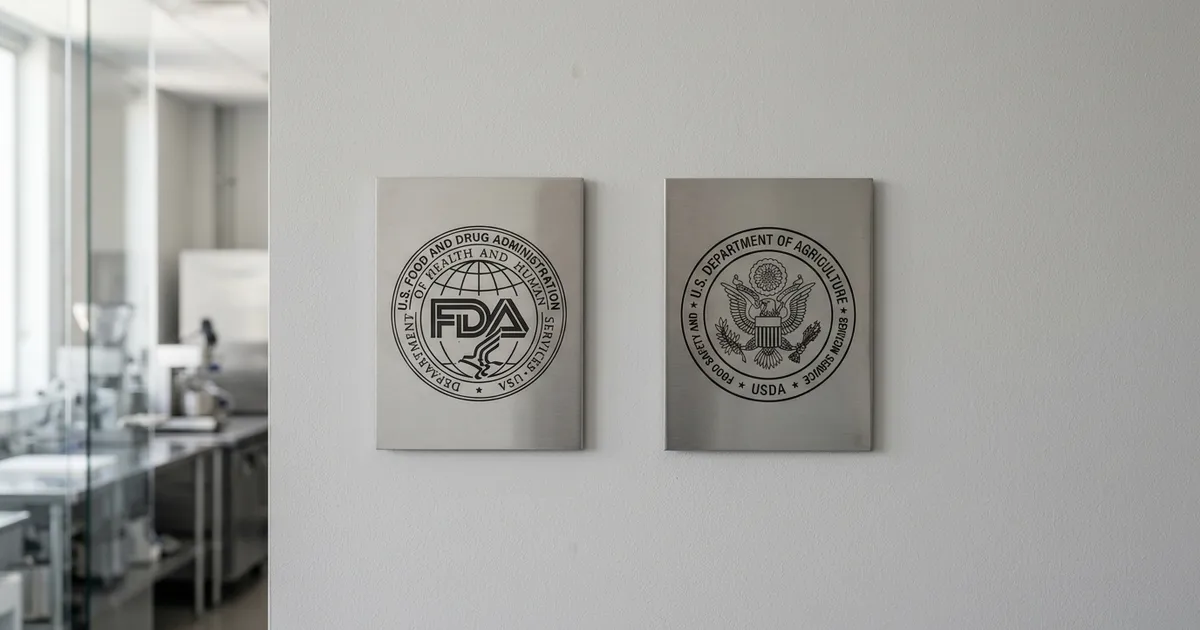
Most first-time food founders start their label research the same way: they look up FDA regulations. FDA 21 CFR Part 101. Nutrition Facts format. Ingredient statement rules. Allergen declarations. That is the right starting point for the majority of packaged foods.
But if your product contains meat, poultry, or a processed egg ingredient, FDA is not the agency that regulates your label. The USDA’s Food Safety and Inspection Service (FSIS) is. And FSIS has requirements that FDA does not, including one that catches a lot of founders off guard: you cannot put a product on the market without first getting your label approved.
Understanding which agency governs your product is not a technical formality. It changes who you submit to, which regulations you follow, and whether a single label review is enough before you print.
Two agencies, two statutes
FDA regulates most packaged food under the Federal Food, Drug, and Cosmetic Act (FD&C Act) and 21 CFR Part 101. Every food product not specifically assigned to another agency falls under FDA’s framework.
FSIS operates under three separate statutes that Congress passed to govern specific product categories:
- The Federal Meat Inspection Act (FMIA, 21 U.S.C. 601-695) covers meat and meat products from livestock
- The Poultry Products Inspection Act (PPIA, 21 U.S.C. 451-470) covers poultry and poultry products
- The Egg Products Inspection Act (EPIA) covers liquid, frozen, and dried egg products
Each statute has its own implementing regulations. Meat labeling falls under 9 CFR Part 317. Poultry labeling falls under 9 CFR Part 381. These parallel many of FDA’s requirements but are not identical, and they add the pre-market label approval step that FDA’s framework does not include.
What FSIS regulates
Meat products. FSIS regulates products from what the FMIA calls “amenable species,” the livestock species covered by federal meat inspection. That list is cattle, sheep, swine, and goats. Products made from these animals and intended for human consumption must be produced under continuous federal inspection and must carry an approved label before they leave the facility.
Game meats such as bison, deer, elk, and rabbit are generally not amenable to the FMIA, which means they fall outside mandatory FSIS inspection and back under FDA’s jurisdiction. Voluntary FSIS inspection is available for those species and some facilities do pursue it, but it is not required.
Poultry products. FSIS regulates products from domestic poultry under the PPIA. Chickens, turkeys, ducks, geese, guineas, and ratites (ostrich, emu, rhea) are all covered. The same continuous-inspection and label-approval requirements apply.
Egg products. Under the EPIA, FSIS has jurisdiction over liquid, frozen, and dried egg products: eggs that have been removed from the shell and processed in some way. Shell eggs sold in their shells go through USDA’s Agricultural Marketing Service for grading but are regulated by FDA for food safety labeling purposes. Freeze-dried egg products, imitation eggs, and egg substitutes fall under FDA, not FSIS.
Siluriformes fish. By a specific act of Congress, inspection of catfish and other Siluriformes fish transferred from FDA to FSIS in 2016. If your product contains catfish, it is FSIS-regulated regardless of the overall product category.

The combination product problem
The jurisdiction question gets more complicated when your product is not purely meat or poultry, but contains both. A soup, a sauce, a frozen entree, a grain bowl. Many products sit at the boundary between FDA and FSIS depending on how much meat or poultry they actually contain.
The thresholds come from FDA’s Compliance Policy Guide Sec. 565.100:
For products containing livestock meat (beef, pork, lamb, goat):
- More than 3 percent raw meat, OR
- 2 percent or more cooked meat
Either condition puts the product under FSIS jurisdiction.
For products containing poultry:
- 2 percent or more cooked poultry meat, OR
- 10 percent or more of cooked poultry skins, giblets, fat, and poultry meat (where meat is less than 2%) in any combination
Either condition puts the product under FSIS jurisdiction.
Below those thresholds, FDA retains jurisdiction. But the thresholds are lower than many founders expect. Adding 2.5 percent cooked chicken to a vegetable soup moves the entire product out of FDA’s framework and into FSIS’s, which changes the label requirements, the approval process, and the production facility requirements at once. None of that is visible from the outside of the package, but all of it is triggered by what is inside.
What FSIS label approval actually means
The requirement with the most practical impact on a founder’s timeline is that FSIS requires labels to be approved before a product is placed in commerce. FDA does not have this requirement. FDA sets the rules, and compliance is largely monitored through post-market surveillance. Under FSIS, approval is a gate.
FSIS Directive 7221.1 and the updated Guideline for Label Approval (FSIS-GD-2025-0006, December 2025) describe how the approval system works. There are two tracks.
Generic approval covers most straightforward labels. A label is generically approved when it meets all applicable FSIS regulations under 9 CFR Part 412.2. The establishment does not need to submit it to FSIS for review before using it. The label is considered approved by virtue of compliance. This track covers the majority of standard product labels with no unusual claims.
Sketch approval is required for a specific category of labels: those bearing special statements or claims. If a label makes a claim about natural or organic status, includes a “raised without antibiotics” or similar production claim, carries a health or nutrient content claim, or uses any other statement beyond the standard mandatory elements, the establishment must submit a sketch label to FSIS’s Labeling and Program Delivery Staff (LPDS) for evaluation before using it.
Sketch labels are submitted through the FSIS Label Submission and Approval System (LSAS) using Form FSIS 7234-1. FSIS recommends the online submission route to avoid delays. Without that approval on file for labels that require it, the product legally cannot be sold.

How the label requirements differ
The substantive label content requirements under FSIS parallel FDA’s in many ways: mandatory elements, Nutrition Facts format, ingredient statement, allergen declarations. But there are meaningful differences.
FSIS requires that covered products display the official USDA mark of inspection, including the establishment number of the plant where the product was produced. That mark is not an optional design element; it is mandatory and must appear in a specific format. Products without it are misbranded under the FMIA or PPIA.
Nutrition labeling for meat and poultry follows 9 CFR Part 317 Subpart B (for meat) and 9 CFR Part 381 Subpart Y (for poultry) rather than FDA’s 21 CFR 101.9. The Nutrition Facts panel format is largely similar to FDA’s current format, but the implementing regulation is different and should be the one you reference for format compliance.
For any product that includes a meat or poultry ingredient at or above the jurisdictional thresholds, the ingredient requirements under FSIS also differ from FDA’s. FSIS has its own standards of identity for many meat and poultry products under 9 CFR Part 319 and 9 CFR Part 381 Subpart P, which specify the minimum content requirements for product names like “chicken soup” or “beef stew.”
A practical starting point
The first question to resolve, before building any label, is which agency has jurisdiction. For the majority of packaged food products, the answer is FDA, and the rest of the label work proceeds under 21 CFR Part 101.
If your product contains meat from cattle, swine, sheep, or goats; domestically raised poultry; processed egg ingredients; or Siluriformes fish, FSIS is your regulatory body. If it contains any of those ingredients as a component, and you are not sure whether the percentage clears the combination product thresholds, that needs to be confirmed before any label work begins.
Getting the agency question wrong costs more than a label revision. It means the label was built under the wrong framework, submitted to no one when FSIS approval was required, and possibly printed and distributed without authorization.
If you are not certain which regulations govern your product, that is a good place to start a scoping conversation. At Complion, we work through the jurisdiction question as part of the initial intake, before any label is built. Book a free call to start.
Rather not learn all this yourself?
Send us your recipe or idea on a free call. We build the full compliant label, the Nutrition Facts panel, the ingredient statement, the allergen declarations, and the print-ready artwork, then our experts verify it against FDA, USDA, Health Canada, and CFIA before it reaches you.
Book a free call to start