Bioengineered Food Disclosure: What the USDA Mandate Means for Your Label
By Eiman Raouf, July 27, 2026
Most first-time food founders spend their label work thinking about FDA requirements: the Nutrition Facts panel, the allergen declaration, the ingredient statement. What a lot of them miss is a disclosure requirement that comes from a completely different agency and sits in its own corner of federal law.
The National Bioengineered Food Disclosure Standard (NBFDS) is not an FDA rule. It is a USDA rule, codified at 7 CFR Part 66, administered by the Agricultural Marketing Service. It became mandatory on January 1, 2022, which means it has been in effect for two and a half years. Labels printed before founders knew about it can be non-compliant and are only discovered at the point of a retailer or co-packer audit.
Here is what the regulation actually says.
Who Is Responsible for the Disclosure
Under 7 CFR Part 66, a “regulated entity” includes food manufacturers, importers, and any other party that labels food for retail sale. For most packaged food brands, that means the food manufacturer or the brand that places its name on the finished product is responsible for ensuring a correct disclosure appears on the label.
There is one threshold that takes many early-stage brands out of scope: the very small food manufacturer exemption. The regulation defines a very small food manufacturer as one with annual receipts of less than $2,500,000. If your business is below that threshold, you are not currently required to comply with the NBFDS. Note that this exemption is based on annual receipts, not product revenue, and that the threshold can change if AMS updates the definition in future rulemaking.
Restaurants and similar retail food establishments are also exempt. Foods produced under USDA organic certification are exempt because the National Organic Program already restricts the use of excluded methods, which includes genetic engineering.
What Foods Trigger the Disclosure
The regulation maintains a specific List of Bioengineered Foods, found at 7 CFR 66.6. You are required to make a bioengineered disclosure if your product contains an ingredient from this list and you cannot provide records showing that the specific ingredient you are using is not bioengineered.
The current list, as of mid-2026, includes:
- Alfalfa
- Apple (Arctic varieties)
- Canola
- Corn
- Cotton
- Eggplant (BARI Bt Begun varieties)
- Papaya (ringspot virus-resistant varieties)
- Pineapple (pink flesh varieties)
- Potato
- Salmon (AquAdvantage)
- Soybean
- Squash (summer, coat protein-mediated virus-resistant varieties)
- Sugarbeet
- Sugarcane (Bt insect-resistant varieties, with mandatory compliance beginning June 23, 2025)
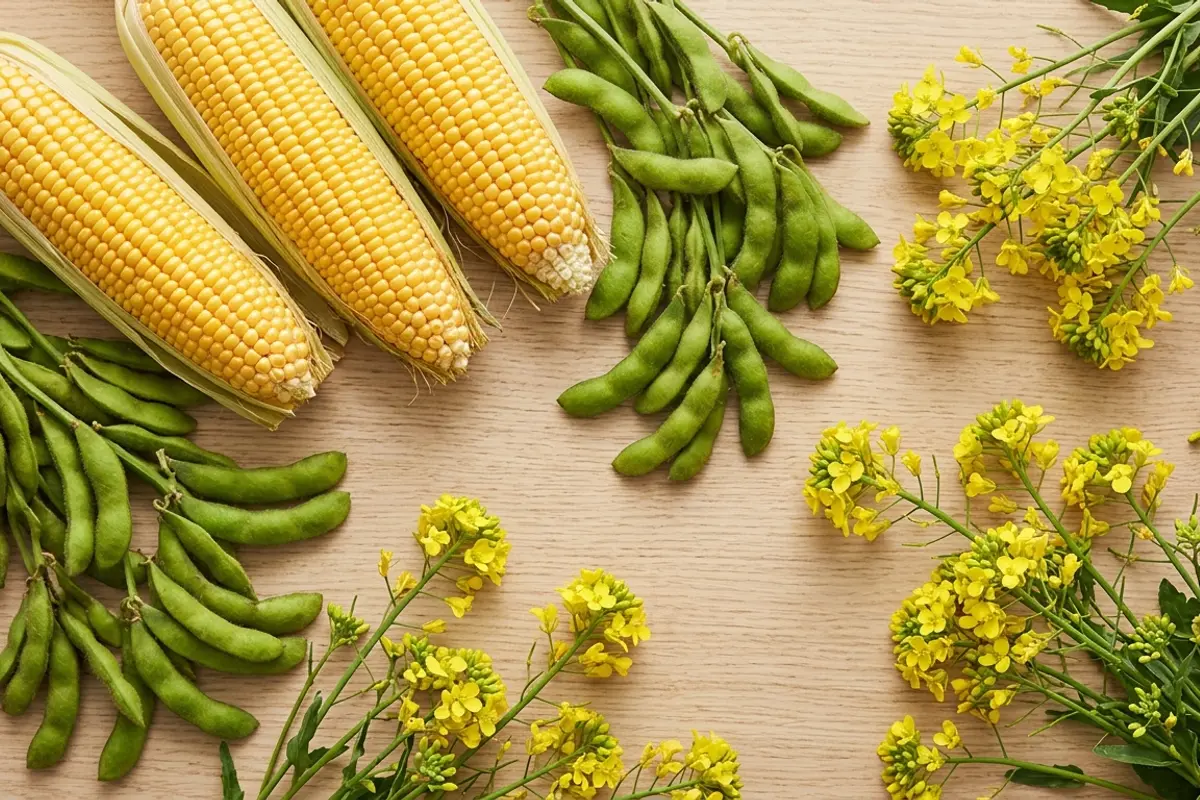
For a packaged food brand, the items that matter most in practice are corn, soy, canola, and sugarbeet. These are commodity crops with significant bioengineered cultivation rates in the United States, and they show up as ingredients or ingredient derivatives across a wide range of processed foods.
The Five Percent Threshold
A food is not automatically subject to disclosure just because it contains an ingredient derived from a listed crop. The regulation allows for inadvertent or technically unavoidable presence of bioengineered material at up to five percent per ingredient without triggering disclosure. If no ingredient in your product intentionally contains a bioengineered substance, and any bioengineered presence is below five percent per ingredient, the disclosure requirement does not apply.
This threshold matters for ingredient sourcing decisions. If you are purchasing commodity ingredients and want to avoid disclosure, you need records from your supplier demonstrating that the ingredient is not bioengineered. Without those records, the default under the regulation is that you must disclose.
What the Disclosure Must Look Like
When the disclosure is required, the regulation at 7 CFR 66.100 through 66.116 gives manufacturers a choice of methods. As of the date of this post, the current rule permits four forms.
Text disclosure. The label must include one of two text statements: “Bioengineered food” (for a food that is itself a bioengineered raw agricultural commodity or consists entirely of bioengineered ingredients) or “Contains a bioengineered food ingredient” (for a multi-ingredient product where one or more ingredients is bioengineered). These phrases are not interchangeable. A granola bar with bioengineered soy uses the second form; bioengineered sweet corn sold as a whole vegetable uses the first.
Symbol disclosure. The official USDA BE symbol is a circular graphic with the word “BIOENGINEERED” and a stylized design. Manufacturers may use it in any color as long as it is clearly legible. The symbol is available from USDA AMS and can replace the text disclosure.
Electronic or digital link disclosure (QR code). Under the current rule, a QR code may be placed on the label accompanied by the statement “Scan here for more food information” or equivalent language. The label must also include a telephone number where consumers can call to receive the disclosure.
Text message disclosure. A statement directing consumers to text a short code for bioengineered food information.
An Important Note on QR Code and Text Disclosures
This is where the current regulatory picture becomes more complicated.
In October 2025, the United States Court of Appeals for the Ninth Circuit issued a ruling in Natural Grocers v. Rollins that found the QR code and text message disclosure options to be insufficient under the statute. The court directed those provisions to be vacated, though it left the timing of that vacatur to the district court.
As of July 2026, the existing rule is still in effect. Neither the QR code option nor the text message option has been formally removed. USDA AMS has indicated, through its 2026 Unified Agenda, that it expects to publish a Notice of Proposed Rulemaking in August 2026 to revise the disclosure regulations in response to the court’s decision.
The practical consequence for a founder designing a label right now: if you are relying on a QR code as your sole disclosure method, you should plan for that option to be unavailable in the near future. Building in a text or symbol disclosure alongside the QR code is the safer path until the rulemaking resolves.

Highly Refined Ingredients and What Changed
The Ninth Circuit ruling also addressed highly refined ingredients. Under the original USDA rule, ingredients that went through processing sufficient to make genetic material undetectable (corn syrup, canola oil, beet sugar derived from bioengineered sugarbeets, and similar) were excluded from the definition of “bioengineered food” and did not require disclosure.
The court found this exclusion to be unlawful. That means highly refined ingredients derived from listed crops may eventually need disclosure regardless of whether the bioengineered genetic material is still detectable. This is not yet effective law while rulemaking is pending, but it is a significant potential change for anyone whose products contain refined corn or soy derivatives and who had assumed no disclosure was needed.
How This Differs from Non-GMO Claims
One point that generates real confusion for founders: the NBFDS and Non-GMO Project certification operate independently.
A “Non-GMO Project Verified” claim is voluntary marketing language. It signals to consumers that a product has been through a third-party verification process. It is not the same as, and does not satisfy, the federal bioengineered disclosure requirement. Conversely, carrying the USDA BE disclosure on your label does not prevent you from making any other label claims, provided those claims are truthful and compliant on their own terms.
If your product uses ingredients you know or believe to be bioengineered, you cannot offset that with a “Non-GMO” marketing claim. The mandatory disclosure is a separate obligation from any voluntary claim you choose to make.
What to Do Before Your Label Is Printed
For a first-time food founder, the practical steps are:
Check whether your business qualifies as a very small food manufacturer (under $2,500,000 in annual receipts). If it does, you are not currently required to comply, though this is worth revisiting as the business grows.
If you are above that threshold, identify every ingredient in your formulation and cross-reference it against the BE food list. For any ingredient derived from corn, soy, canola, sugarbeet, or another listed crop, contact your supplier and request documentation on whether the ingredient is bioengineered. Keep those records.
If disclosure is required, decide on your disclosure method. Given the current uncertainty around QR codes, a text or symbol disclosure on the label is the lowest-risk approach right now.
Build that disclosure into your label artwork before it goes to print. Adding it after the artwork is set is a redesign; getting it wrong in print means a reprint.
Complion’s label build process includes an assessment of whether a product requires a bioengineered food disclosure, and a food compliance expert reviews the label against the current NBFDS requirements before the finished files are released. If you have a product with commodity ingredients and you are not sure whether a disclosure is needed, book a free call to start.
Rather not learn all this yourself?
Send us your recipe or idea on a free call. We build the full compliant label, the Nutrition Facts panel, the ingredient statement, the allergen declarations, and the print-ready artwork, then our experts verify it against FDA, USDA, Health Canada, and CFIA before it reaches you.
Book a free call to start